Jeanne Modigliani
Daughter of Jeanne Hébuterne and Amedeo Modigliani, she was born in Nice but grew up, after the death of her father and the subsequent suicide of her mother in 1920, with her paternal grandmother Eugénie Garsin in Livorno.
She graduated in Pisa in art history with a thesis on Vincent van Gogh. Persecuted by fascism because she was Jewish, she took refuge in Paris. When France was occupied by the Nazis, she joined the Maquis, the French Resistance, and was also imprisoned for political reasons. During that period she married Mario Levi, brother of Natalia Ginzburg, as Ginzburg herself recounts in "Family Lexicon", for reasons merely related to citizenship. The two divorced shortly thereafter.
In 1952, with a scholarship from the National Center for Scientific Research, Jeanne undertook research on Van Gogh, in France and the Netherlands. Thanks to her study of Van Gogh and the stereotype of the cursed artist, she decided to study the life of her father Amedeo Modigliani and in 1958 wrote the book Modigliani, senza leggenda, published by Vallecchi Editore. This work dismantles the various rumors surrounding her father's memory, particularly attacking the one who promoted the reputation of the cursed artist, namely André Salmon, author of "Vita e passione di Amedeo Modigliani" published in 1926, but who had already written an article in 1922 focused on Bohemian Paris. The text centers its reflection on a single question: why did Modigliani drink? Salmon describes his excessive drinking and use of hashish, with interviews, anecdotes, but without specific biographical notes. As a historian, however, his daughter Jeanne sticks to the facts, while being aware that it is objectively impossible to write a complete biography. One would have to map all the studios and homes where Modigliani lived but, given the numerous moves, this is not possible. Even in his mother's diary, which unfortunately breaks off during the most interesting periods, some streets are confused.
Some elements, on the other hand, are discovered thanks to a valuable document that narrates the history of the Spinoza and Modigliani families since 1793:
debunks the myth of the family of philosophers. In fact, it seems that Modì boasted in Paris of a false descent from Baruch Spinoza: his great-grandmother was a Spinoza but was not related to the great philosopher, moreover she never married and had no children;
debunks the legend of the family of bankers. Everyone thought they were, but the father was just a merchant and had an ancestor who had indeed worked for the Vatican mint, but only as the person responsible for copper procurement. Thanks to that job he bought a few hectares of land, but it was later expropriated because at that time Jews could not own land.
debunks the rumor of Lyonese Jewish origins. The mother's surname is not Garcin - as written by Salmon - but Gaslin.
it debunks the legend that Modì began painting in 1898 during a typhoid fever attack, as he had actually started earlier, in 1896, purely out of passion.
debunks the legend of the lack of family support and abandonment without burial in Paris. There is a letter sent by the mother to the last art dealer Zaborowskij that said "cover him with flowers, I will reimburse you." The brother, deputy Emanuele, took a month to get to Paris, due to the demobilization following the war. The trips to Florence and Venice were paid for by Uncle Amedeo and the one to Paris by the mother, who always supported her son, even though she was not swimming in gold.
debunks the legend that Modì attended Fattori's nude academy in Florence in 1902 and in Venice the following year.
debunks the legend of a Modigliani who practiced sculpture as a second choice and abandoned it to take up painting. His first love was sculpture and he had to give it up for several reasons: first of all for his health, since when he arrived in Paris he was already ill. Sculpting marble was too strenuous, it was unhealthy because of the dust that was inhaled; moreover, it was more expensive than painting due to the costs of the large studios it required. He was often seen in the garden or outside sculpting stones that friends brought him and which he left everywhere because he could not transport them.
debunks the legend of his Parisian training: Modì, according to his travels and his references, was trained in Italy as stated by the art historian Enzo Carli. Jeanne documents that the only study Modì did was on the fourteenth-century sculptures of Tino di Camaino, first in Naples, where he stayed to recover from a convalescence, and later in Florence.
The only three critical studies that attempt to bring order and that publish documents with verifiable biographical notes are:
Jeanne Modigliani with her "Modigliani Without Legend";
Giovanni Scheiwiller with "Homage to Modigliani" from 1930;
Enzo Maiolino "Modigliani from Life" 1964 and second edition 1981.
Her constant commitment to obtaining official recognition of her father's work achieved an important success in 1981, when she organized the most comprehensive Modigliani exhibition held up to that time in Paris: over two hundred and fifty works including paintings, sculptures, gouaches and drawings.
She died in 1984 in Paris (three days after the discovery in Livorno of the three fake heads erroneously attributed to Modigliani) from a cerebral hemorrhage following a fall. She was divorced and left two daughters, Anne and Laure: she had married Mario Levi, brother of Natalia Ginzburg, as can be read in the book Family Lexicon.


Archives
Amedeo Modigliani
J. Lanthemann
The Archives of the works of Amedeo Modigliani curated by Prof. Joseph Lanthemann, have an incommensurable historical and artistic value, having been “authorized”, by public act in 1969 in Paris, by his daughter Jeanne Modigliani, the sole universal heir of all legal rights to her father's works.
The Archive contains numerous original letters and still unpublished historical documents of enormous importance.
Professor Joseph Lanthemann, already the author of several publications in the field of art, was considered the only true expert and scholar of the works of Amedeo Modigliani.
All the works present in the "Modigliani, Catalogue Raisonné, sa vie, son œuvre complet, son art", were previously viewed, studied, and authenticated directly by Madame Jeanne Modigliani, before publication.
It is important to further remember that all the works catalogued by J. Lanthemann with Jeanne Modigliani, as the sole universal heir of all legal rights to the works of Amedeo Modigliani, are therefore to be considered "authentic" for all legal purposes.
The Catalogue Raisonné was printed in Barcelona in 1970 in a limited edition of 2,500 copies worldwide.
The works not included in this 1970 catalogue will therefore be subject to study and verification by the J. Lanthemann Scientific Committee.
It goes without saying the cultural importance these archives have in the international art world.
Portrait
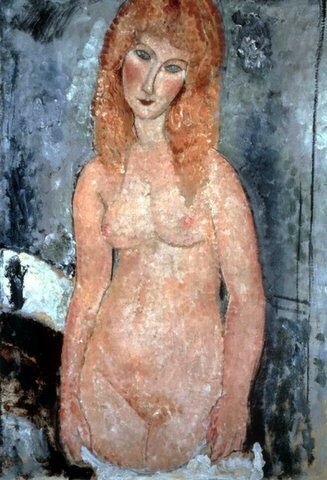


Nu Blonde
standing with shirt lowered
1917
Oil on canvas
92 x 65 cm (36 1/4 X 25 5/8 inches)
Signed “Modigliani” upper right
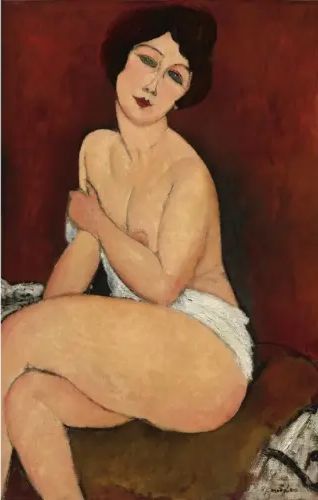
Nu Assis sur un Divan
(La Belle Romaine)
Painted in 1917
Oil on canvas - 100 by 65 cm
Signed Modigliani (lower right)
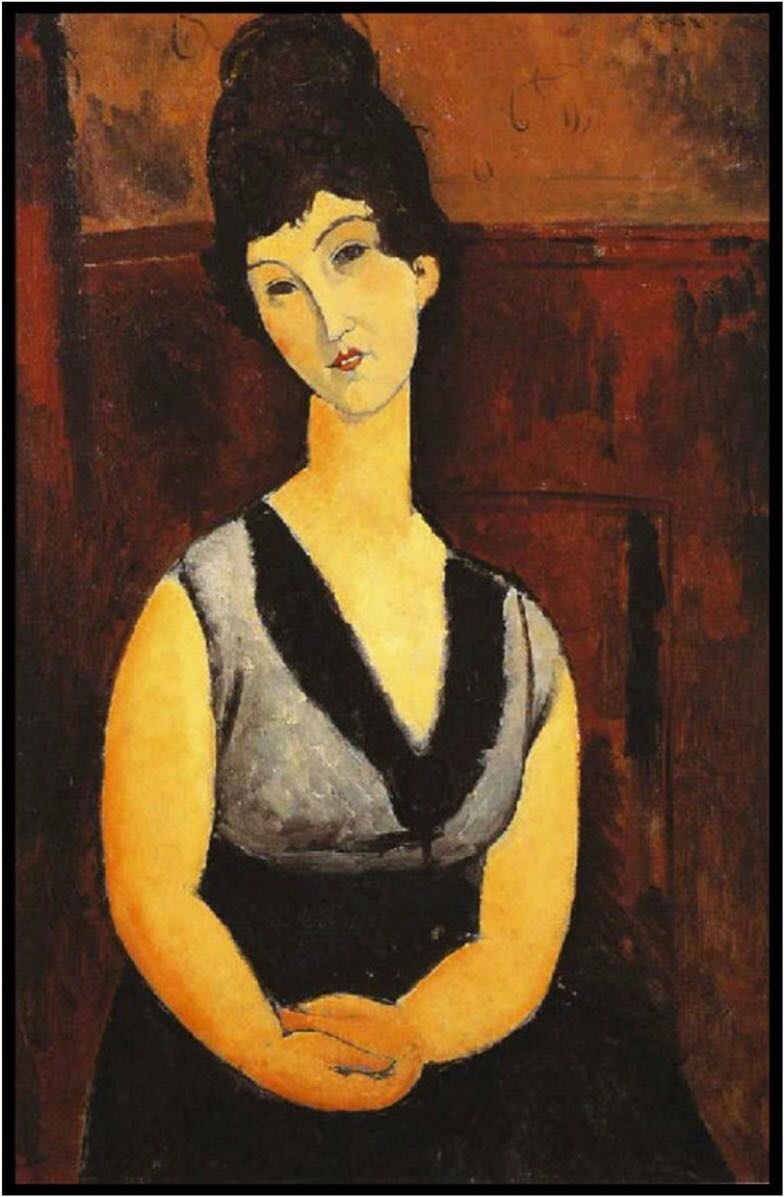
La Belle Chocolatière
circa 1916-1917
Oil on canvas - 99 x 65 cm.
Signed upper right "Modigliani"
PROVENANCE:
Leopold Zborowski, Paris (acquired from the artist)
Dr. Raymond-Jacques Sabouraud, Paris (most likely acquired from the above and until his death in 1937)
Georges Renand, Paris (probably acquired through a dealer from the estate of the above, and sold: Drouot-
Montaigne, Paris, November 20, 1987, lot 6)
Private Collection, Asia (sold: Sotheby's, New
York, November 11, 1999, lot 125)
EXHIBITED:
Zürich, Kunsthaus, Italian Painters, 1927, no. 106
Paris, Galerie Charpentier, Cent chefs-d'oeuvre des peintres de l'Ecole de Paris, 1946
Paris, Galerie Charpentier, Cent chefs-d'oeuvre d'art francais, 1947, illustrated in color in the catalogue
Paris, Musée national d'Art Moderne, L'Art Moderne Italien, 1950, no. 49 (titled Nu assis)
Rome, VI National Art Quadrennial, Amedeo Modigliani, 1951-52, no. 13
Tokyo; Osaka; Sapporo; Nagoya, Mitsukoshi, La Ruche-Ecole de Paris et Montparnasse, 1978, no. 56
Paris, Musée Jacquemart-André, La Ruche et Montparnasse, 1978-79, no. 94
Paris, Musée d'Art Moderne de la Ville de Paris, Amedeo Modigliani, 1981, no. 54, illustrated in color in the catalogue
(titled Nu assis sur un divan, La Belle Romaine)
Düsseldorf, Kunstsammlung Nordrhein-Westfalen & Zürich, Kunsthaus, Amedeo Modigliani, Painting, Sculptures,
Drawings, 1991, no. 62, illustrated in color in the catalogue (titled Nu assis)
LITERATURE:
Maurice de Vlaminck, "Modigliani," L'Art Vivant, Paris, 1925
"Gemälde von Modigliani," Deutsche Kunst und Dekoration, Darmstadt, July 1925, illustrated
André Salmon, Modigliani, sa vie et son oeuvre, Paris, 1926, illustrated pl. 6
Mark Schwartz, Modigliani, Paris, 1927, illustrated pl. XI
Arthur Pfannstiel, Modigliani, Paris, 1929, catalogued p. 24
Michel Georges-Michel, Les Montparnos, Paris, 1929 (revised edition), illustrated p. 189
"Amedeo Modigliani," Deutsche Kunst und Dekoration, Darmstadt, January 1931, illustrated p. 245
René Huyghe, French paintings, the Contemporaries, Paris, 1940, illustrated pl. 6
Georges Besson, 1900-1940, Amplepuis-Rhône, 1944, illustrated pl. 18
Rafaello Franchi, Modigliani, Florence, 1944, ilustrated pl. 11
Rafaello Franchi, Modigliani, Florence, 1946, illustrated pl. XIX
Pierre Descargues, Modigliani, Paris, 1951, illustrated on the cover
Enzo Carli, Modigliani, Rome, 1952, illustrated pl. 17 and on the cover
Paolo d'Ancona, Modigliani, Chagall, Soutine, Pascin - Aspects of Expressionism, Milan, 1952, illustrated pl. 18
Paul Ferdinand Schmidt, Geschichte der Modernen Malerei, Zürich, 1952, illustrated pl. 16
"Homage to Amedeo Modigliani," Rivista di Livorno, Livorno, July-August 1954, illustrated pl. 14
Georges Poisson, The Woman in Modern French Painting, Novara, 1955, illustrated pl. 44/a
E. Lavavigno, Modern Art, vol. II, Turin, 1956, illustrated p. 1033
Arthur Pfannstiel, Modigliani et son oeuvre, Etude critique et catalogue raisonné, Paris, 1956, no. 147, fig. 31,
illustrated p. 114
Marcel Brion, Modern Painting from Impressionism and Abstract Art, Paris, 1957, illustrated p. 81
Jean-Albert Cartier, Modigliani- Nudes, Paris, 1958, illustrated pl. 15
Ambrogio Ceroni, Amedeo Modigliani, Painter, Milan, 1958, no. 129, illustrated in color pl. 129 (titled Nu assis (on the
divan) and as dating from circa 1917-18)
Franco Russoli, Modigliani, London, 1959, illustrated pl. 21
Corrado Pavolini, Modigliani, Milan, 1966, illustrated pl. 14
Alfred Werner, Amedeo Modigliani, New York, 1968, illustrated p. 135
Gaston Diehl, Modigliani, Lugano, 1969, illustrated p. 69
Csorba Geza, Modigliani, Budapest, 1969, illustrated pl. 15
Nello Ponente, Modigliani, Florence, 1969, no. 50
Ambrogio Ceroni & Leone Piccioni, The Paintings of Modigliani, Milan, 1970, no. 192, illustrated p. 97 and pl. XXXIII (as
dating from 1917)
Joseph Lanthemann, Modigliani, 1884-1920- Catalogue raisonné, sa vie, son oeuvre complet, son art, Barcelona,
1970, no. 141, illustrated in color p. 196 (titled Nu assis)
Ambrogio Ceroni & Françoise Cachin, All the Painted Works of Modigliani, Paris, 1972, no. 192, illustrated p. 97 and in
color pl. XXXIII
Carol Mann, Modigliani, London, 1980, no. 102, illustrated p. 142
Bernard Zurcher, Modigliani, Paris, 1980, illustrated pl. 39-40
Modigliani, the years of sculpture (exhibition catalogue), Museo Progressivo d'Arte Contemporanea, Livorno, 1984, no.
23A, illustrated p. 123
Gaston Diehl, Modigliani, New York, 1985 (revised edition), illustrated p. 59
Claude Roy, Modigliani, Geneva, 1985, illustrated pp. 100, 104 and in color on the dust jacket
Alfred Werner, Amedeo Modigliani, New York, 1985, illustrated p. 107
Thérèse Castieau-Barrielle, The Life and Work of Amedeo Modigliani, Paris, 1987, illustrated in color p. 149
Angela Ceroni, Amedeo Modigliani- The Nudes, New York, 1989, no. 18, illustrated in color p. 71
Christian Parisot, Modigliani, catalogue raisonné, paintings, drawings, watercolors, vol. I, Livorno, 1990, illustrated p.
152; vol. II, 1991, no. 33/1917, illustrated in color p. 169 (Nu assis sur le divan (La Belle Romaine))
Werner Schmalenbach, Amedeo Modigliani, Paintings, Sculptures and Drawings, Munich, 1990, illustrated in color pl.
62
Osvaldo Patani, Amedeo Modigliani, General Catalogue, Milan, 1991, no. 195, illustrated in color p. 205 (titled Nude
seated on a divan)
Victoria Soto Caba, Modigliani, The Timeless Face, Madrid, 2008, illustrated in color p. 328
Provenance:
Collection Henri Galilée, Paris (1875 - 1937)
Alex Reid & Lefèvre, London (acquired before 1929)
Collection D.M. Mc Donald, London
Galerie Bignou (in the 1940s)
Collection Vladimir Horowitz, New York
Paul Rosenberg and Co., Inc.
Collection David E. Bright, Los Angeles
Collection Mrs. Dolly Bright Capen (by descent)
On deposit at the Los Angeles County Museum, Los Angeles
Private collection
Bibliography:
Dale Maud, Modigliani, New York, 1929, pl.16
WILENSKI R.H., Modern French Painters, London, Faber and Faber, 1940, p. 258, pl. 76
LANTHEMANN J., Modigliani 1884-1920. Catalogue Raisonné, Barcelona, Graficas Condal, 1970, p. 119, no. 173, p. 206
Exhibitions:
Palais des Beaux Arts, Brussels, Modigliani, 1933; Kunsthalle, Basel, Modigliani, 1934; The Museum of Fine Arts, Boston, Massachusetts, Modigliani, Paintings and Drawings, Jan 19 to Feb 26, 1961, p. 46, no. 23; Los Angeles County Museum of Art, The David E. Bright Collection, Oct 17 to Dec 17, 1967, p. 31; Soviet Union, Paintings from American Collections, 1976, the Ministry of Culture of the Union of Soviet Socialist Republics; The Armand Hammer Foundation; Occidental Petroleum Corporation; Hermitage Museum, Leningrad; Pushkin Museum, Moscow; Ukrainian State Art Museum, Kiev; Belarusian Museum of Fine Arts, Loan no. 5732; Musée Marmottan, Paris, Masterpieces from US Museums - from Giorgione to Picasso, Oct 13 to Dec 5, 1976, no. 31 reproduced
Los Angeles County Museum of Art, Selections from the Twentieth Century Art Collections, Nov 10 to Dec 18, 1983; Los Angeles County Museums of Arts, Selections from the Twentieth Century Permanent, Jan 9 to Feb 12, 1985; Musée du Luxembourg, Paris, Modigliani, The Angel with the Grave Face, Oct 23, 2002 – Mar 2, 2003, pp. 242-243, no. 47 (incorrect dimensions).
Notes:
Reproduced as early as 1929 by Maud Dale (Modigliani, New York 1929, pl.16) and exhibited the same year in London by Alex Reid & Lefevre (as no. 7), this magnificent portrait was long hung on the walls of the Los Angeles County Museum of Art. Galerie Bignou, which owned it in the 1940s, indicated it as executed in Nice in 1918 (Bignou Documentation, Musée d'Orsay, D. 65, titled "Femme aux mains croisées", rep.). It seems rather to have been painted during the course of 1916. Unfortunately, the identity of this beautiful chocolate maker is still unknown: it is clearly not Mrs. Menier, whose portrait Modigliani also painted (La Femme au collier vert, Ceroni no. 233). In any case, Alex Reid & Lefevre acquired it, before 1929, from a "Galilée collection, Paris". A famous collector of Lorraine origin, Henri Galilée (1875-1937) left Le Havre for Paris in 1910 and the Musée de Nancy now preserves the Portrait of Germaine Survage with earrings by Modigliani (Ceroni no. 277) which belonged to him. (Cf. Cat. Exp. Musée du Luxembourg, Paris, Modigliani. The Angel with the Grave Face, 2002-03, p. 242).
Provenance
Leopold Zborowski, Paris
Francis Carco, Paris
Jos Hessel, Paris
Galerie Druet, Paris, Hotel Drouot, Paris, March 2 1939, Lot 158 (illustrated)
Roger Dutilleul, Paris
Jean Masurel, Paris
Christie’s New York, Lot 337, Nov. 19th, 1998 (Bought in)
Private Collection, New York
Private Collection, South America
Exhibitions:
Galerie Berthe Weill, Paris, Amedeo Modigliani, Peintures et Dessins, December 1917
Palais des Beaux Arts, Brussels, Modigliani, November 1933, cat. no.66 illustrated page 33
Kunsthalle, Basel, Modigliani, January-February 1934, cat.no.57
Galerie de France, Paris, Modigliani: Peintures, December 1945-January 1946, cat.no.26
Palais des Beaux????Arts, Lille, Un demi siecle de peinture francaise 1900-1950, June-July 1950
Kunsthalle, Basel, Basler Privatbesitz, June-September 1957, cat.no.695
Musee d’Art Moderne de la Ville de Paris, Paris, Amedeo Modigliani, March-June, cat.no.45
Literature:
F. Carco, Modigliani, L’ Eventail, July 15, 1919, page 207
F. Carco, Le nu dans la peinture moderne, Paris, 1925, illustrated on cover
G. Scheiwiller, Modigliani, Milan, 1927, page 10
G. Scheiwiller, Modigliani, Paris 1928, page 8
G. Scheiwiller, Modigliani, Milan 1932, plate XX
G. Scheiwiller, Modigliani, Milan 1936, plate XXI
R. Franchi, Modigliani, Florence 1944, page 22
R. Franchi, Modigliani, Florence 1947, plate XLI
G. Jedicka, Modigliani, Zurich 1953, plate 33
R. Salvini, Guida delle Arte moderna, Florence 1949, page 37, illustrated plate 5
A. Pfannsteil, Modigliani et son oeuvre, Paris 1956, page 141,
cat.no.263, illustrated page 150 and plate 38
J-A Cartier, Modigliani Nus, Paris 1958, page 11
A. Ceroni, Amedeo Modigliani peintre, Milan 1958, page 62, cat.no.123, illustrated plate 123
G. Diehl, Modigliani, Lugano 1969, page 40
J. Lanthemann, Modigliani Catalogue raisonné, sa vie, son oeuvre complet, son art, Barcelona
1970, page 124, cat.no.224, illustrated page 225
A. Ceroni, I dipinti di Modigliani, Milan, 1972, pages 97-98, cat.no.193, illustrated page 97
C. Mann, Modigliani, London 1980, page 213, cat.no.108, illustrated in colour page 150
B. Zurcher, Modigliani, Paris 1980, cat.no.52
T. Castieau Barrielle, La vie et loeuvre de Modigliani, Paris 1987, page 155
A. Ceroni, Les nus de Modigliani, Paris 1989, page 73, cat.no.19, illustrated
C. Parisot, Modigliani Catalogue raisonne, Livorno 1991, vol.II, page 311, cat.no.29
O. Patani, Amedeo Modigliani, Catalogo Generale, Dipinti, Milan 1991, page 207, cat.no.197, illustrated.
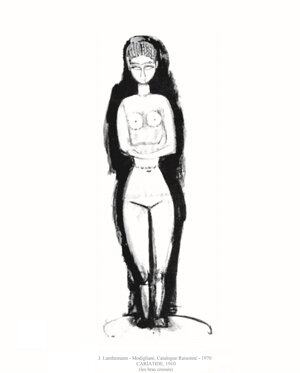
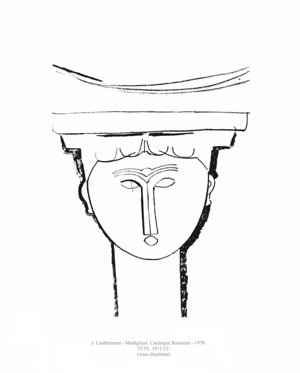
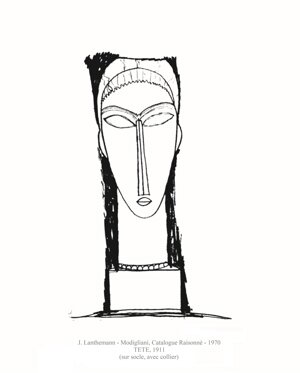
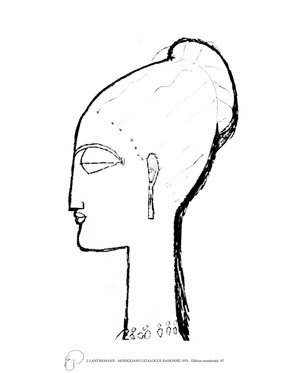
Les Cariatides
Première Sélection d'Oeuvres
J. Lanthemann – “Catalogue raisonné complet des oeuvres de Modigliani" – 1970
"The Caryatids of Modigliani"
"Art Nègre and the Value of Spirituality"
First numbered collector's selection, made in 100 copies and composed of five reproductions of works published in the "Complete Catalogue Raisonné of the Works of Modigliani" edited by Joseph Lanthemann in 1970 and authorized by public deed by the artist's daughter, Madame Jeanne Modigliani, sole universal heir to all her father's rights.
In the early years of the 1900s, interest in what was defined as Art Nègre grew ever stronger, especially among those artists seeking ascetic and allegorical purity. An art different from the innovative contemporary and previous avant-gardes. An art with distant origins that bases its value not so much on forms and aesthetic appearance, but on transmittable meaning, on ritual and religious significance. A new artistic movement circulated through the streets of Paris, which at that time represented the central point for art, for innovative artistic ideals that inspired new works. All this is easily identifiable in Modigliani's drawings with the Caryatids.
Between 1905 and 1906 in Paris, African art began to fascinate more and more artists who, interested, studied and reworked the new forms proposed. An artistic ideal already known since the nineteenth century, but which only took hold in those years. Modigliani, attracted by the novelty, examined and adapted African art, making it his own. He extracted various elements and combined them with his classical training to develop a unique genre, which can be identified in its true suggestion: portraits.
Basic and reduced forms to their essence, corpulent volumes and well-marked lines are the essential points of his graphic and pictorial production between 1909 and 1913. To best understand this new art, one must strip down and return to a primitive state. This is what Modigliani, Picasso, Brancusi, Matisse and others did, who discovered and showed the public the true essence of black art, the deepest, the hidden one, which does not concern mere aesthetics, but a more rooted value, the spiritual one, that of the soul.


The Woman with Macarons
Amedeo Modigliani
"La Femme aux macarons"
Executed in 1917
Technique: Oil on canvas
Dimensions: 60.4 x 46 cm.
Signed: Modigliani at the top left
Private collection
Catalogue J. Lanthemann, n° 208
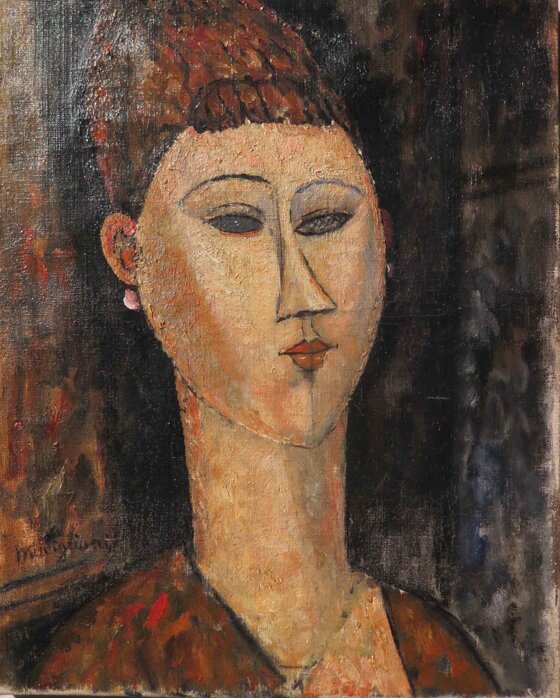
Head of Woman with Red Hair
Amedeo Modigliani
"Tête de femme aux cheveux rouges"
Executed in 1915
Technique: Oil on canvas
Dimensions: 41 x 33 cm.
Signed: Modigliani lower left
Private collection
Catalogue J. Lanthemann, no. 53

Conrad Moricand
Amedeo Modigliani
"Portrait of Conrad Moricand" - "L'Homme au Chapeau"
Executed in 1915
Technique: Oil on canvas
Size: 46 x 38 cm.
Signed: Modigliani at the top right
Private collection
Catalogue J. Lanthemann, no. 81
Name:
Archive Headquarters:
Contact:
Registered Office:
Archives
Amedeo Modigliani
J. Lanthemann
Via Soldini 12 - 6830 Chiasso - Switzerland
Piazza Indipendenza 3 - 6900 Lugano - Switzerland
© Amedeo Modigliani Archives - J. Lanthemann