Jeanne Modigliani
Daughter of Jeanne Hébuterne and Amedeo Modigliani, she was born in Nice but grew up, after the death of her father and the subsequent suicide of her mother in 1920, with her paternal grandmother Eugénie Garsin in Livorno.
She graduated in Pisa in art history with a thesis on Vincent van Gogh. Persecuted by fascism because she was Jewish, she took refuge in Paris. When France was occupied by the Nazis, she joined the Maquis, the French Resistance, and was also imprisoned for political reasons. During that period she married Mario Levi, brother of Natalia Ginzburg, as Ginzburg herself recounts in "Family Lexicon", for reasons merely related to citizenship. The two divorced shortly thereafter.
In 1952, with a scholarship from the National Center for Scientific Research, Jeanne undertook research on Van Gogh, in France and the Netherlands. Thanks to her study of Van Gogh and the stereotype of the cursed artist, she decided to study the life of her father Amedeo Modigliani and in 1958 wrote the book Modigliani, senza leggenda, published by Vallecchi Editore. This work dismantles the various rumors surrounding her father's memory, particularly attacking the one who promoted the reputation of the cursed artist, namely André Salmon, author of "Vita e passione di Amedeo Modigliani" published in 1926, but who had already written an article in 1922 focused on Bohemian Paris. The text centers its reflection on a single question: why did Modigliani drink? Salmon describes his excessive drinking and use of hashish, with interviews, anecdotes, but without specific biographical notes. As a historian, however, his daughter Jeanne sticks to the facts, while being aware that it is objectively impossible to write a complete biography. One would have to map all the studios and homes where Modigliani lived but, given the numerous moves, this is not possible. Even in his mother's diary, which unfortunately breaks off during the most interesting periods, some streets are confused.
Some elements, on the other hand, are discovered thanks to a valuable document that narrates the history of the Spinoza and Modigliani families since 1793:
debunks the myth of the family of philosophers. In fact, it seems that Modì boasted in Paris of a false descent from Baruch Spinoza: his great-grandmother was a Spinoza but was not related to the great philosopher, moreover she never married and had no children;
debunks the legend of the family of bankers. Everyone thought they were, but the father was just a merchant and had an ancestor who had indeed worked for the Vatican mint, but only as the person responsible for copper procurement. Thanks to that job he bought a few hectares of land, but it was later expropriated because at that time Jews could not own land.
debunks the rumor of Lyonese Jewish origins. The mother's surname is not Garcin - as written by Salmon - but Gaslin.
it debunks the legend that Modì began painting in 1898 during a typhoid fever attack, as he had actually started earlier, in 1896, purely out of passion.
debunks the legend of the lack of family support and abandonment without burial in Paris. There is a letter sent by the mother to the last art dealer Zaborowskij that said "cover him with flowers, I will reimburse you." The brother, deputy Emanuele, took a month to get to Paris, due to the demobilization following the war. The trips to Florence and Venice were paid for by Uncle Amedeo and the one to Paris by the mother, who always supported her son, even though she was not swimming in gold.
debunks the legend that Modì attended Fattori's nude academy in Florence in 1902 and in Venice the following year.
debunks the legend of a Modigliani who practiced sculpture as a second choice and abandoned it to take up painting. His first love was sculpture and he had to give it up for several reasons: first of all for his health, since when he arrived in Paris he was already ill. Sculpting marble was too strenuous, it was unhealthy because of the dust that was inhaled; moreover, it was more expensive than painting due to the costs of the large studios it required. He was often seen in the garden or outside sculpting stones that friends brought him and which he left everywhere because he could not transport them.
debunks the legend of his Parisian training: Modì, according to his travels and his references, was trained in Italy as stated by the art historian Enzo Carli. Jeanne documents that the only study Modì did was on the fourteenth-century sculptures of Tino di Camaino, first in Naples, where he stayed to recover from a convalescence, and later in Florence.
The only three critical studies that attempt to bring order and that publish documents with verifiable biographical notes are:
Jeanne Modigliani with her "Modigliani Without Legend";
Giovanni Scheiwiller with "Homage to Modigliani" from 1930;
Enzo Maiolino "Modigliani from Life" 1964 and second edition 1981.
Her constant commitment to obtaining official recognition of her father's work achieved an important success in 1981, when she organized the most comprehensive Modigliani exhibition held up to that time in Paris: over two hundred and fifty works including paintings, sculptures, gouaches and drawings.
She died in 1984 in Paris (three days after the discovery in Livorno of the three fake heads erroneously attributed to Modigliani) from a cerebral hemorrhage following a fall. She was divorced and left two daughters, Anne and Laure: she had married Mario Levi, brother of Natalia Ginzburg, as can be read in the book Family Lexicon.

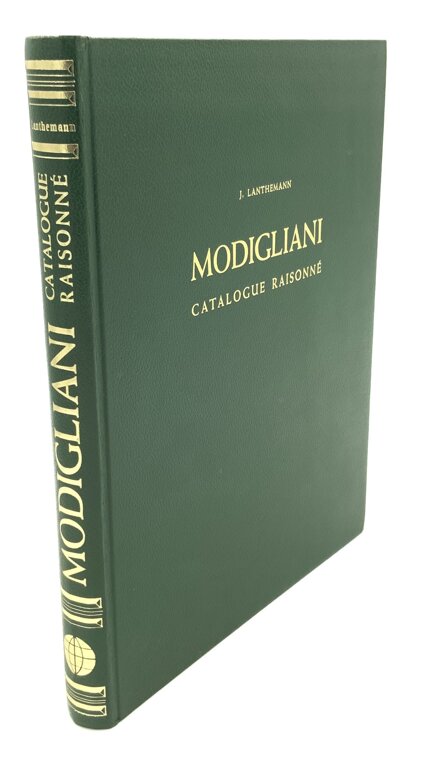
Modigliani 1884-1920
Catalogue raisonné
His life, his complete works, his art.
Texts by Jeanne Modigliani.
Title: Modigliani: Catalogue Raisonne, 1884-1920
Publisher: Graficas Condal - Barcelona - Spain
Publication date: 1970
Binding: Hardcover
Edition: 1st Edition
Copies: 2,500 numbered copies
Availability: On request